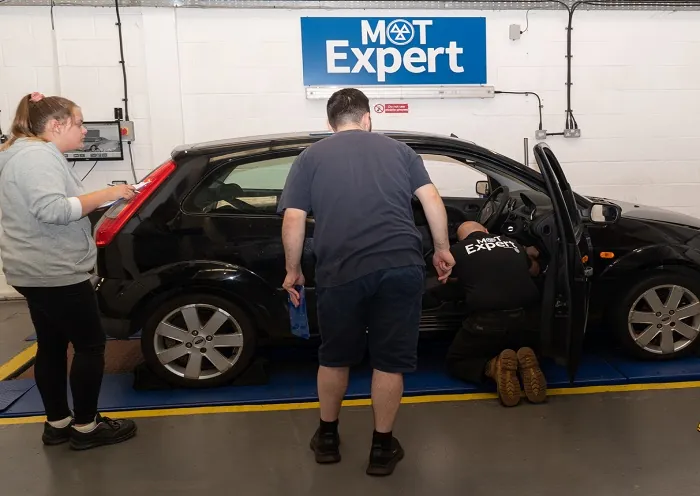
When you are in MOT training, you should be aware that in the automobile and passenger vehicle MOT tests, the axle, wheel bearing, wheel and tyres, tyre pressure monitoring system (TPMS), and suspension (including springs, shock absorbers, and suspension arms and joints) inspections are mandatory and required government standards have to be followed by the vehicle owner. Road wheels are an integral part of the MOT tests conducted annually every year and when you are in the MOT training program, you should also be aware of the conditions required for the road wheels to pass the MOT test. At the time of the inspection, you simply need to examine the vehicle’s road wheels fitted at that particular period and if you find a flaw on a spare wheel, you should notify the car presenter. Wheel hub caps must not be removed at any particular point in time. And as long as the retainer is suitably and safely situated in the wheel rim, you can accept abutting ends on detachable spring retaining rings on semi-drop center type wheel rims (recognized by the ends of the ring formed to interlock).
In an MOT test, there are standards which you have to comply such as the tyre’s aspect ratio should be incorporated into the size marking. A 215/55R15 tyre, for example, has a 55 percent aspect ratio. ‘Standard’ automobile tyres have a notional aspect ratio of 82 percent (unless otherwise specified), and they are nearly equal in size to tyres with an aspect ratio of 80 percent. On a vehicle, they can be safely blended in any arrangement. Some tyres may have two sizes labelled on them. A 185/75R14 tyre, for example, may be dual labelled 185R14. You can accept either marking in such instances. When it comes to loading rating (for category 5 and 7 vehicles), The maximum burdened weight of an axle is specified on the manufacturer’s plate. If axle weights are not shown on the manufacturer’s plate, you must presume that the load capacity of the tyres is adequate unless there is irrefutable proof to the contrary.
In an MOT management course, you will get to understand the structure, suitable conditions, and fitments of a road wheel, when it comes to structuring the tyres of various construction kinds, such as radial-ply and cross-ply, must not be combined on the same axle. Steel and fabric radial-ply tyres are believed to have the same construction, although run-flat and regular tyres can be blended on the same axle, it is not advised in your MOT management course. And, when it comes to conditions and fitments, Evidence of a tyre touching a vehicle component, such as owing to tyre flexing or suspension movement, is not considered a fault. A vehicle should be rejected only if the tyre is fouling a section of the vehicle during testing. Some cars include lock stops that consist of rubbing pads on the body with which the front tyres may come into contact during a full lock. These are okay as long as they are properly maintained and do not harm the tyres. When analyzing cuts in a tyre, it is permitted to use a blunt object to open the cut and verify whether it is deep enough to reach the ply or cord, taking care not to do more damage.
There are some conditions you should be aware when you are asserting tyre cuts in your MOT management course. As you are in MOT training, you will be advised to follow these conditions to fail the tyre in the MOT testing.
- any ply or cord that can be seen without touching the tyre
- if exposed ply or cord can be seen regardless of the size of the cut by folding back rubber or opening a cut with a blunt instrument, so as not to cause further damage
- if a cut that is more than 25mm or 10% of the section width, whichever is greater, is opened with a blunt instrument and cords can be felt but not seen
Before failing a cut, make sure you can feel the cables and not a strange item. If you are unsure, you should pass and advise.
The final assessment you should do as an MOT tester is the inspection of tyre pressure monitoring system (TPMS) and the tyre age, which is introduced for M1 vehicles first used on or after January 1st, 2012. Depending on the vehicle type, the TPMS warning bulb might function in a variety of ways. You must reject cars only if it is evident that the lamp indicates a system fault rather than just displaying that one or more tyre pressures are low. And when it comes to tyre age, except for vehicles of historical relevance, the tyre age check applies to all vehicles with more than 8 passenger seats. The date code on the sidewall, which will be three or four digits, determines the age of the tyre. Tyres with a three-digit code are over ten years old. The code is often found in a ‘window’ on the sidewall and may or may not be seen at the end of the DOT number.